
I Lost $80,000 on a Single Webinar. Here’s Why I’m Glad It Happened.
What would you do this week if you were just ten percent less scared?
Hold onto that question. I’m going to come back to it, because almost every conversation I have with women building online businesses eventually lands on fear. And here’s the surprising part: for most of the women I coach, the loudest fear in the room is fear of success. What if I get so visible that my relationship dynamic changes? What if I get so successful I stop wanting to spend time with my kids? What if everything I want comes true and it turns out different than I imagined?
Those feelings are completely normal. And the fear underneath them is actually legitimate, because when you run a visible online business with clients and a team and real ad spend, things will go wrong. That part is unavoidable. What I want to show you is that going wrong and going under are two very different things. I have a hundred percent survival rate from every worst-case scenario that has ever hit my business, and I want to walk you through three of them.
The week I spent $80,000 on a webinar nobody attended
There was a stretch where I was spending up to $100K a week on Meta ads driving people to a weekly live webinar. One particular week, we spent $80,000 on ads for a single presentation.
Then the tech broke.
A team member had missed updating a date in the email delivery sequence, so the emails went out with the wrong information and no working link. Eighty thousand dollars of traffic, and nobody knew when the webinar was or how to get there. I sat in GoToWebinar watching an empty waiting room, waited five minutes, and felt my stomach drop as I realized what had happened. I nearly threw up. I remember sitting on my porch crying into Voxer messages to my coach, Julie Chenell, saying I had no idea what to do.
Here’s what she helped me see: I was too close to it. When you’re inside a crisis, your brain treats the worst-case scenario like an ending. You can’t see the label from inside the bottle. Julie helped me reframe the whole thing as a plot twist that needed a plan B.
So we built one. We promoted an encore webinar to my email list, did a big social push, created a story around why the encore existed, and ran it again. The following week we recovered the entire ad spend and made two times what we’d spent. The situation that felt like it would end my business turned out to be completely survivable, and even profitable.
I’ll be honest with you, though. My body still remembers that feeling. Scaling ad spend still brings up that core memory of watching money burn. Recovering financially and recovering emotionally happen on different timelines, and both are part of the work.
The clients who formed a group just to talk about me
When I first launched my group coaching program, about twenty to twenty-five people came into the first cohort. A marketer on my team pushed me to open a second cohort and add them into the same community and calls. It felt off to me, but he was the expert I was paying for exactly this kind of guidance, so I went with it.
A group of about five women from that first cohort got genuinely angry that I’d added people to what they saw as a closed container. In hindsight, I understand their frustration completely. What I still don’t understand is what they did next: they created a private Facebook group, called themselves the Tiny Offer Rebels, and recruited people into it for the sole purpose of talking trash about me. The whole group existed to say I was greedy, my system didn’t work, and I was a bad person.
That one cut deep, because I was badly bullied through elementary, middle, and high school. Being the target of a group of women turning on me pressed directly on one of my oldest wounds. And it followed a pattern I’ve now seen play out for so many online creators: people love bomb you when they discover you, and then when they want a reason to avoid doing the work, you become the villain overnight.
Here’s what matters, though. My exact fear came true, and I didn’t die. I came out of it with better boundaries, a real education in the psychology of rolling enrollment, and a much deeper understanding of what clients believe they’re entitled to when they join a cohort. I learned firsthand what happens when you change a container without preparing people for it, and that knowledge now protects every program I run.
The team member who made me feel like a fraud
The third story is about hiring, and about what happens when you hand your confidence to someone else along with the strategy.
I had a consultant in a CMO-type role who was genuinely good at pushing me past my comfort zone. He pushed me to send more emails, pitch harder, raise prices, and spend at levels I never would have touched alone. My brand grew fast because of that push, and I want to be fair about that.
But there was a dark side. On the day I won my Two Comma Club award, one of the proudest moments of my career, with my family up on stage with me, he said, “Wow, it’s really not fair that you get to be on stage when I’m the one doing all the work.”
That one sentence poisoned the whole thing. I couldn’t enjoy the moment. For a long time afterward, I couldn’t even look at the award on my wall without hearing that I didn’t deserve it. And I’ve noticed how differently this lands for women. A man in my position would likely have thought, “I hired you because I’m smart.” Instead, I defaulted straight to feeling like a fraud, and there’s real data on how quickly women sink into feeling less than.
Eventually I bought out his contract to get him off my team, and I went into significant debt to do it, because of what his presence was doing to my energy and self-belief. The $80K webinar disaster happened right after that, so I was already depleted when it hit. It took me a long time to climb out and to believe again that I was the one driving the strategy, that people came for my frameworks, and that hiring an expert to help you scale takes nothing away from your own expertise. If someone you hired makes you feel small, you’re looking at a personality problem on their end. That was never evidence about your worth.
What therapy taught me about all three stories
I put myself in therapy recently to digest all of this, and I found the thread that runs through every story: control and people pleasing. I believed I could control how every person interpreted me at every turn. I believed that if I behaved the right way, people would have to like me. Hypervigilance like that is a trauma response, and I genuinely think every entrepreneur should be in therapy, because your business is always downstream of your self-beliefs.
This shows up in my clients constantly. On a coaching call last week, a client admitted she’d been turning down her ad spend. Her ads were profitable. Everything was working. When I asked why, she didn’t have an answer beyond a vague feeling that she was spending too much. That feeling was scarcity talking, the same “what if I become too much” fear dressed up as prudence.
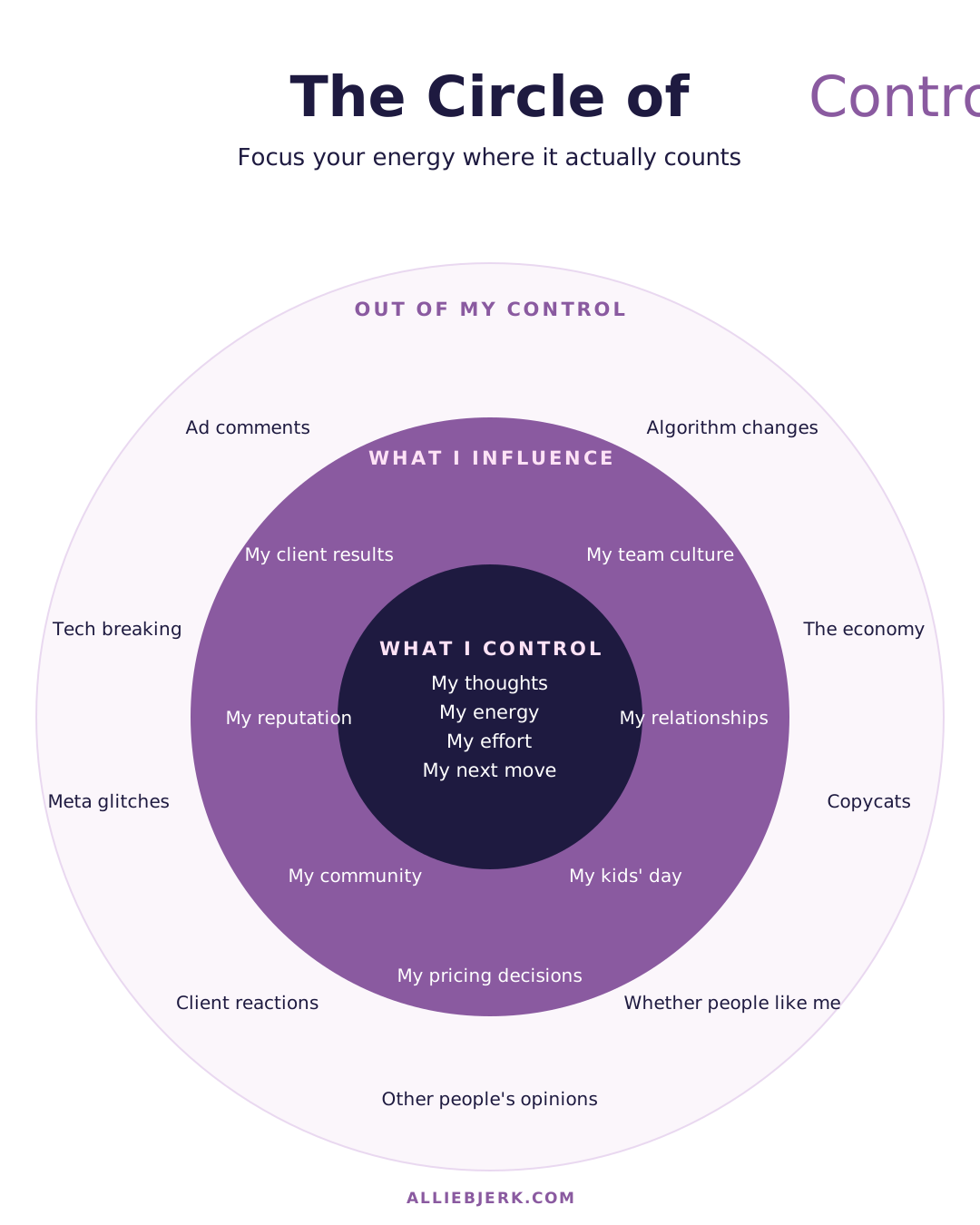
The framework that reframed this for me is the circle of control. Picture three rings. The center is you: your thoughts, feelings, energy, and actions. That’s the only ring you fully control. The middle ring is your sphere of influence, things like your relationships, where your behavior has impact without guaranteeing outcomes. The outer ring holds everything else: the behavior of people you hire, comments on the internet, clients who join your program and find a reason to be mad at you. Every single thing I feared lived in that outer ring, which means no amount of vigilance was ever going to prevent it.
The growth all happens in the center circle. Your energy, your effort, your next move.
So, what would you do if you were ten percent less scared?
Doing it scared looks tangible and specific. It looks like scaling the campaign that’s working even though your body remembers the last time ads went sideways. Posting the video. Putting your name on your framework. Owning your expertise even without the certification you think you need, because helping people rarely requires the credential your fear insists on.
You don’t need to be less afraid before you make the next move, and you don’t need to know exactly how it turns out. You just have to make the next slightly bigger move. Start tiny, show up a little bit bigger than your fear wants you to, and let yourself get a little uncomfortable.
So answer the question honestly. What would you do this week if you were just a little less scared?
Now go do some version of that.
This post is based on an episode of the Start Tiny Show. Listen to the full episode wherever you get your podcasts, and if it resonated, send me a DM and tell me what you’re doing scared this week.