
The Latest Episode
Loading the newest episode for you.
Build Your Scalable Offer With Me
The podcast is where we talk about it and the workshop is where we build it together, live, in one focused hour.
-
Some weeks, life feels subtle. Other weeks, it feels like life is standing in front of me with a giant neon sign that says, “Allie, are you seeing this?” Last week was one of the neon-sign weeks, and almost everything that happened came back to one thing I’ve been learning about myself as I scale my business again: how much I rely on control to feel safe.
The feeling I hadn’t felt since 2020
I’m going to keep the details vague, because other people are involved and some of them listen to the podcast. Something happened in my business that brought up a very specific kind of fear and scarcity. It was a mix of protectiveness, comparison, and almost territorial energy around what I’ve built. There was fear that something could be taken from me, and fear that someone else was becoming more valuable and that it was somehow making me less valuable.
I recognized that feeling almost immediately. The last time I felt it this strongly was around 2020, during one of the biggest growth periods of my business.
I’ve spent years looking back at that period trying to understand what happened. Why did I burn out? Why did I pull back so dramatically and dismantle things that were actually working? When there were more opportunities, more people, and more money, why did I end up making my business smaller?
There are probably a hundred answers, but I’m starting to think one of them is that the success started to feel unsafe. I wanted it and I felt I deserved it. But more success meant more exposure, more personalities, more responsibility, more opinions, more chances to be disappointed, copied, or compared, and more chances for someone to get close enough to what I’d built that I could lose a piece of it. Somewhere in my brain, growth got connected to danger, and contraction started to feel like safety. So I stopped the weekly webinar that was scaling my business, and I let go of team members who were helping me grow.
Scarcity can be quieter than “not enough”
We usually think of scarcity as not enough money, not enough clients, or not enough opportunity. For me, it often sounds more like this:
- What if what I already have isn’t safe?
- What if someone learns what I know and starts competing with me?
- What if someone else is becoming more important to my clients than I am?
- What if I’m too generous?
- What if what I’ve built is more fragile than I realize?
None of those things is necessarily happening. Scarcity, at least for me, is often an attempt to protect today from an imagined future loss. My brain is five steps ahead, trying to make sure the loss never happens. And that’s where control comes in.
What a dog attack showed me about control
The day after the business stuff came up, I took my dog Griffin out for an early morning walk by the lake. He’s a 10-year-old Australian Shepherd, and with construction near our house, I hadn’t been walking him. That morning I decided I was done waiting.
Partway through the walk, we came up on a woman with two off-leash dogs. They sprinted at Griffin, growling and snarling, jumping on him and baring their teeth at his face. I was pulling him back, yelling swear words, and screaming at the woman. Griffin was fine, not a scratch on him (thank you, Aussie fluff). I was furious, and I walked away without saying another word.
What surprised me was what I replayed afterward. I kept going over my own reaction: what I said, how I sounded, whether I was too much, whether I should have told her it was okay.
I’m extremely aware of my own responses, probably too aware. I always have an observer in my head asking, “Okay, Allie, how are we doing here? Are we being reasonable?” When I was in labor with one of my kids, a nurse looked at my husband and said, “She’s scary,” because I was so composed through the pain. That’s very me. During the dog attack, though, there was no pause. My body responded before my intellect did. When the observer came back online and reviewed the footage, I realized I kept replaying it because I had experienced myself out of control, and that was deeply uncomfortable.
Control has been one of my safety nets for a long time. I feel safer when I understand what’s happening, when I can anticipate what people will do, when I know everyone’s motivations, and when I can predict the outcome. In business, that can look like wanting to control who joins my group coaching programs and courses so I can make sure they’ll like it, and like me.
Rumination is a form of control
Why replay something that’s already over? Griffin was okay and the moment had passed. I think rumination is one more way of trying to get control back. If I replay it enough, maybe I find the perfect response and I’m ready next time.
That isn’t how life works, though. Some things you can’t prepare your way out of, and sometimes your nervous system gets there before your brain does. Growing a business works the same way. You can’t predict every scenario that walks in your door, shows up in your Slack channel, or comes across as a comment on your ads. Scaling is, by and large, an uncontrolled situation. Something will always come out of left field.
A different definition of safety while you grow
I’ve been talking a lot about capacity on the podcast lately. It’s tempting to believe the most evolved version of ourselves is calm all the time: never rattled, never jealous or scared or angry, always regulated and measured. Honestly, that sounds exhausting.
Maybe capacity is trusting yourself even when you temporarily lose it. Maybe it’s being able to have a messy, 100% fear-based human reaction without turning it into a crisis about who you are.
Once I saw that, I could see the same pattern in my business. When I feel threatened, I want to know everyone’s intentions, what’s happening behind the scenes, and what comes next. I want to pull things closer and not share them. That’s exactly what I did in 2020: protect more, watch closely, reduce the variables, make my world smaller. Underneath it was the belief that I’d be okay as long as I controlled everything around me.
You can’t hire people and control every aspect of their work. You can’t have a community full of different personalities and control every interaction. You can’t run ads to strangers and expect everyone to respond the same way. So the definition of safety I’m practicing now is this: I’ll be okay even when I’m not in control.
That doesn’t mean I’m not allowed to feel threatened. Feelings happen. And abundance doesn’t mean abandoning discernment.
Two opposite answers to the copycat problem
In 2020, copycats were everywhere. Everybody had their own version of Tiny Offers: mini offers, pocket offers, you name it. People sent me DMs and screenshots of sales pages that ripped off mine. Some of them were people in a peer mastermind I’d looked up to for more than five years, and they copied my copy word for word. That copy came straight out of my brain at 2 a.m. in a Google Doc, so I knew it.
I asked two people for advice. Frank Kern, who I was doing one-on-one coaching with, said, “Forget it, dude. You’re so far ahead of them, they’re never going to be able to keep up. Create another product. Let them copy you.” Todd Herman said to sue them, get as many attorneys involved as possible, and make an example of them.
Ultimately I’m more of a Frank Kern vibe. I put my policies in place and sent the cease and desists I needed to send (at roughly $600 each, sending about 10 a month really sucks). What I took from it is that the two responses were wildly different, each one was right for the person giving it, and I had to find my own way.
What’s different this time
The biggest difference between 2020 Allie and 2026 Allie is that I’m not abandoning my feelings, and I recognize my patterns a lot faster. This time I felt the feeling in my gut before I’d fully figured out what was happening in the business, and I knew: I’ve been here before, and I remember how I reacted. After six years of thinking about that, I don’t want to let it shrink me again.
So now I’m practicing being able to:
- Notice a behavior I don’t like without catastrophizing what it means
- Put a boundary in place without building it out of panic
- Protect things without being territorial
- Let other people in my world be brilliant without deciding their brilliance is a threat
- Let someone else help my clients without it meaning I’m being replaced
When clients get even better results than I’ve gotten, I should celebrate that. There’s enough for everybody, and everybody gets to win.
I have a lot of compassion for 2020 Allie. She was holding more than she’d ever held. Our biggest sales day was a $200,000 day, and it blew my mind. She was doing the best she could to make herself feel safe. I’ve already lived the ending that path leads to, and this time I’m choosing a different response.
Letting yourself receive
The rest of that Sunday kept proving I’m not in control of anything. Right after the dog attack, a neighbor I’d never met stopped me to ask how I looked so beautiful at 8 a.m. (with day-and-a-half-old makeup). She ended up telling me her husband of 24 years had just moved out, and I gave her a long Disney hug. At Starbucks, while I was getting her a gift card with my daughter, my high school crush, who I hadn’t seen since I was 17, asked, “Is your name Allie?” The day before, at an open house, the agent had recognized me from my college dorm. And that evening, a client messaged out of the blue asking for a payment link for a VIP day. There was $5,000 in my Stripe account within 20 minutes.
I believe in energy and synchronicities, and I’ve been consistent. This is the first time I’ve ever posted seven podcast episodes in a row. When I turn my energy all the way on, I see it reflected back in my content, my sales, and the people who show up.
Part of that is learning to receive: compliments without immediately deflecting, new leads I deserve, and payments I don’t need to feel bad about. My nervous system tends to say, “Okay, that’s enough, you can stop now.” Growth is going to come with moments you can’t control, and you’re going to be okay.
Questions to sit with
- When you feel threatened in your business, what do you reach to control?
- Are your boundaries coming from discernment or from panic?
- Is there a feeling you recognize from a past growth season, and how did you respond last time?
Listen to the full episode
I tell the whole story in this week’s episode of Start Tiny with Allie Bjerk, including more about the 2020 copycat chapter and what I’m practicing now as I scale. Listen on Apple Podcasts, Spotify, Amazon Music, or YouTube.
If it resonates, send it to one or two friends who’d like it.
-
The $11,000 Email: Building the Capacity to Scale Your Business
I used to think that once I was more successful, I’d have fewer problems. Once I hit $100K months, things would be easy. If I could only make a million dollars a month, I’d finally have my stuff together, better systems, more support and fewer things going wrong.
I don’t think that anymore, and I actually believe the opposite is true.
More success means making more decisions. It means more money moving through you, more people relying on you, more visibility, more opportunities and more logistics, and it also means more things that can break and more moments where things don’t go according to plan. The successful people I know have developed a larger container for managing all of that stress.
That’s what I’ve been thinking about for the last week or so: capacity.
What I mean by capacity
I’m talking about how much can happen around you without it completely hijacking you. How much uncertainty can you hold inside your business? How many problems can come up before your entire day becomes about the fact that something negative happened?
And more importantly, how quickly can you experience something stressful, disappointing, frustrating, embarrassing or just unexpected, and then find your way back to neutral?
I think one of the biggest gaps between where we are now and the level we tell ourselves we want to reach is often a capacity issue. The business you say you want to run won’t get there until you become the version of yourself who can handle it, the version of you who doesn’t think everything is a big deal and comes back to neutral really efficiently.
My friend Stacy Tuchel runs a business that’s approaching $2 million a month. The last time I got to mastermind with her, she described it as whack-a-mole. Every time she turns around there’s another problem to solve or something surprising her, and she just has to handle it.
The $11,000 email
Recently I got an email out of the blue from my payroll and retirement benefits provider. It said they’d gone through their reports, realized a payment hadn’t processed correctly at some point in the past, and I owed them $11,000. They’d be debiting it from my account in the next couple of weeks.
It was so cryptic that I almost thought it was spam. The issue was supposedly from 2022 or 2023, about three years ago. I emailed them back, called customer support and got on their chat, trying to find anyone who had a clue what they were talking about. I spent about two hours that afternoon uploading every past payroll report and every dollar I’d put into my retirement account to Claude and asking it to reconcile everything. I had employees back then, so I wondered if someone’s retirement hadn’t been funded correctly. I couldn’t find it.
But at no point was I distraught. I wasn’t crabby, I wasn’t crying and I wasn’t calling my husband in a tizzy. I knew it was going to be okay whether I had to cough up $11K unexpectedly or not, because I believed in my ability to solve the problem without catastrophe.
That ability is something I learned over the last decade of entrepreneurship. I had to learn how to move from problem to problem without catastrophizing and without huge emotional swings in my highs and lows, staying close to that baseline.
Stop adding meaning to things that just are
Back in 2012, when I was a baby entrepreneur designing WordPress websites, I went to a networking event and a guy asked what I charged. I told him $1,200, and he laughed in my face and said he’d never pay that much for a website.
It crushed me for weeks. It was still replaying in my head months later. Was I charging too much? Did he not take me seriously? Was I not a real business owner? I would ruminate forever on comments like that.
Now when someone tells me I’m too expensive, I’m like, okay, cool, no worries, go find less. I have no emotional response whatsoever.
One of the things I worked on with a mindset coach back in the day was not adding meaning to things that don’t need meaning. His opinion was that he wouldn’t pay that much, and my price was $1,200. It just is. It didn’t mean he was cheap, it didn’t mean I was overpriced or a bad business owner, and it didn’t mean any of the other stories I was spinning up. The more you can detach from adding meaning to things, the easier your life gets.
What I learned watching a $25 million business owner
A few years ago I spent a weekend with my friend Bill Allen. I stayed in his guest room with his wife and three young kids, spoke at an event he was hosting and helped coach in one of his programs. We went to the gym together, I sat in his office while he hosted meetings, and I rode in his car while he took calls and did deals. I got to be a fly on the wall for someone whose business was doing around $25 million a year.
Over those three days I watched important meetings, deals falling through, family things, people who needed him, a phone that wouldn’t stop ringing and decision after decision. His nanny was late, his kids were right there, and he moved through all of it with so much ease.
I remember looking at his calendar and thinking I could never run a business like that. Things that were a simple conversation for him would have consumed my energy for hours. Part of me was even thinking, gosh, I’m glad my business is simpler.
But Bill was still present. He was generous, he was laughing with his team, he was connecting with his family and he was getting his workouts in. At one point we were driving between meetings, he took a stressful phone call, and afterward I noticed him taking deep breaths. I asked if he was doing breathwork, and he said yes, he was trying to get back to his stable zone.
He had little rituals that most people would never see. He wasn’t carrying the stressful thing from 9 a.m. into his 2 p.m. meeting, then carrying the 2 p.m. problem home to dinner and taking all of it to bed. He had built that capacity over time.
Watching him, I realized capacity is how effectively you can complete the stress cycle and come back to neutral.
Why this matters when you want to scale
I’ve been thinking about this a lot as I set goals of $100K and $250K months again. I want to build an empire, and I’ve finally let myself believe that’s possible. I also have three kids in every activity known to man, and I’m the primary caregiver. I could tell myself I don’t have the bandwidth to grow a company and be the mom and partner I want to be, call it a season of life and shut it down.
Lately I’ve been called to expand my capacity instead. I can use AI to save a ton of time. I can hire great A-player team members, attract dreamy clients and have ads and launches that work, and I can believe I deserve to scale without losing myself or my family in the process.
If you’re an online entrepreneur saying you want more clients, a bigger audience, a team, stages, a book or events, you also have to accept the duality that comes with it. More clients means occasionally more unhappy clients. More money means money can temporarily go sideways. More visibility means more criticism. As your capacity expands, you have more room for the good too.
And if a bad thing takes you three days to recover from, eventually your nervous system starts protecting you from growth. That can look like procrastination, staying small, overplanning or waiting for the perfect time. You might hesitate to commit to anything because part of you doesn’t trust yourself to handle the emotional aftermath if it goes wrong.
So ask yourself how long you’re going to let something own you. Ten minutes? An hour? The rest of the afternoon? Three days?
Capacity means feeling it without becoming it
Building capacity still means caring. I can get detached really fast, especially with hiring and leadership, and building capacity has meant letting myself have my feelings.
One evening recently my husband and I were both crabby, and his energy was affecting mine while I folded laundry with my kids. The harder I tried not to be affected, the more frustrated I got. What helped was admitting it: okay, this is affecting me. I can feel it without getting lost inside it.
The next morning I journaled, went for a run, looked at my to-do list and handled it, and I was back to my baseline. Movement is a huge piece of my capacity. I can build an empire after I’ve gone for a run.
Find your reset and start tiny
Part of expanding your capacity is knowing what brings you back. For me it’s often a run. For you it might be breathwork, a walk outside, a silent walk with no music, driving without your phone, sitting quietly for 10 minutes, talking to someone you love, a shower, music, going to bed early, cleaning your kitchen, prayer, journaling, good food, closing your laptop or laughing with your kids.
Then build those resets into your life before you desperately need them. A coach once had me set breathing timers on my phone throughout the day. I’d close my eyes, do box breathing for a couple of minutes, imagine that favorite-sweater feeling and then go back to work. So many amazing things happened while I was doing that practice, probably because I believed I could regulate and come back to neutral.
You can practice on tiny things. When my kids were little and tantruming, I’d take a sip of coffee, look out the window at complete chaos and focus on how warm and good that coffee felt. For a minute I was back to myself and could handle whatever was happening. You don’t have to wait for a crisis, an annoying text, broken tech or a flopped launch to start.
And to close the loop on that $11,000 email: a week and a half later, they emailed to say it was an error on their end and to just ignore it. Good thing I didn’t freak out.
The goal is to know you’ll be shaken sometimes and to always know how to find your way back. There’s an incredible amount of freedom in that.
Listen to the full episode
Listen to the full episode above for the whole story, including more from that weekend with Bill and the frog-in-the-pot idea I can’t stop thinking about. If it resonates, send me a DM on Instagram and tell me what it meant to you. I love getting your messages.
And if you want to be around entrepreneurs having these conversations alongside the business strategy, come check out Tiny Offer® HQ at tinyoffer.com/hq.
-
The Call Is Coming From Inside the House: The Beliefs Keeping Your Business Stuck
This is a little weird to admit, but sometimes a phrase gets stuck in my head and I can’t shake it for the whole week. I start wondering what it’s trying to tell me. Why this sentence? Why does it keep popping back up?
Last week, the phrase was “the call is coming from inside the house.” I’m pretty sure I picked it up from a novel I’m reading, and it just stuck. The idea behind it is that the thing you assume is coming from outside of you is often coming from your own beliefs, your own judgments, and the rules you’ve made for your life.
So I sat with it. Here’s what came up, and why I think it matters for anyone building a business on their own name.
When I burned out, I didn’t go looking for more strategy
Around April or May of this year, I was in a funk in my business. I didn’t know if I wanted to keep doing the same thing. It felt like it wasn’t meaningful or impactful enough. (That’s the season that led to my comeback episode about deciding Tiny Offers were, in fact, enough.)
When I first started my business, I consumed every strategy podcast and business book I could get my hands on. If you’ve ever seen me on video, those are the books lined up on the shelves behind me. And I’ve read every one of them. But I hit a point where I couldn’t read any more. It all felt like the same advice regurgitated in a different wrapper. Looking back, that exhaustion was a canary in the coal mine. I felt like I’d lost my mojo, and I was questioning my motivation, my excitement, and my purpose.
What pulled me through was a different kind of content. I started listening to podcasts about the nervous system, self-belief, confidence, and the underlying felt side of business. And I realized something: I’ve never been short on strategy. I’m a strategist. I teach it, coach it, and work directly with private clients on it. When I was stuck, I didn’t ask ChatGPT or Claude to map out a new plan for me, because I knew the problem was me.
When the pattern interrupt becomes the pattern
The same sameness I felt with business books is showing up on social media right now. Last week, I screenshotted every post I saw with the word “quietly” in it (as in, someone “quietly” used ChatGPT to do something). I ended up with about 15 screenshots just from casual scrolling.
One of the first marketing lessons I ever learned is that once the pattern interrupt becomes the pattern, people tune it out. When a lot of people are having AI create their carousels and their images, everyone starts to look the same.
That’s why finding your edge matters. What do you really care about? For me, the answer showed up in where I went for help when I was stuck. It also showed up in what my brain always wants to learn about. And it’s the underlying reason Tiny Offers have worked since I started teaching them in 2018.
The belief that what I do isn’t enough
Content note: this section mentions a death by suicide.
Some of our beliefs sit so far under the surface that we don’t even know we have them. One of my big ones is that what I do isn’t enough. It’s not deep enough, not big enough, not mass-market enough.
A year and a half ago, my cousin died by suicide. I used to babysit him, and his mom is my godmother. I was crushed. Sitting at his funeral, right in front of the lake with the waves splashing the whole service, I told my dad that this kind of thing really makes you think about your purpose. I wanted to lead a bigger life and do something that actually mattered.
My dad looked at me and said, “What do you mean, do something that matters? What you’re doing is massively impactful. You’re changing people’s lives. You’re showing them what’s possible.”
And the little girl in me tilted her head and said, “Really? You think my work matters?” I honestly thought he might see it as a waste of time. We’re all kind of little kids running around in adult bodies, and we still want our parents’ validation.
That moment showed me how many stories I carry about my work. The biggest one is that I sell things on the internet to other people selling things on the internet, so none of it is real. When I look for examples of online business, the blips that stand out to me are the bro marketers and the people who overpromise and underdeliver. Then I lump myself in with them. It’s hard to show up fully when part of you is equating your work with everything you dislike.
And, pausing business for a moment in honor of my beautiful cousin Ben, please, if you’re struggling, just stay another day. Get support. You can call or text 988 to reach the Suicide & Crisis Lifeline in the US.
Why Tiny Offers work: you change while they’re working
I’ll happily talk about funnels, ads, and conversion events all day. But I have to admit that the strategy works when the other stuff is also working.
I’ve had so many coaching calls where someone gets their ads working for the first time and says, “I don’t know what to do with my time now. This feels so easy.” Sales start showing up like Monopoly money, and they’re shocked. Getting there takes a huge amount of self-belief.
This is the part people miss about Tiny Offers. They work because you’re changing as they work. The people who finish their offers, who test lots of different things without giving up, who run ads that flop the first two or three times and keep going — those are the people who change their lives with Tiny Offers. They’ve looked in the mirror and thought, “This isn’t working. I suck. It’s never going to work for me.” And then they kept showing up, and one day the ad worked. They made a sale to a stranger and thought, holy crap, my life is about to change.
That first sale is proof you can do it, and you only get that proof by taking the action.
What your judgments reveal about your rules
Here’s a useful exercise. What kind of content do you judge? What kind of entrepreneur makes you roll your eyes or cringe? Your answers can help you clarify your values. Keep an eye on where those judgments quietly turn into rules, though.
A few examples:
- You got burned by a high-ticket program. Maybe you spent a lot on a mastermind and the creator was nowhere to be found. Now your rule might be “high ticket rips people off” or “selling is obnoxious,” so you barely sell and never ask for the sale.
- You had a big team with a tiny profit margin. This one’s mine. My belief became “big team equals more revenue and more stress, and no more profit.” There are ways to run a high-revenue business with strong profit, and that’s what I’m working on now. But if I don’t watch that belief, it could keep me from hiring even when I’m drowning.
- You think personal brands are narcissistic. Then you’ll hide behind educational content and introduce yourself with a serious title so people take you seriously.
That last one is me, too. My siblings are both medical doctors, and I’m the weird artist marketer who was always smart but too rebellious to act like it. I have old stories about needing to prove I’m smart, or else I’m just selling snake oil. It has always felt more legit to tell the moms on the sidelines at sports games that I’m a marketing strategist than to say I help people through the fear, behavior, and avoidance psychology of running a business.
Strategy and the felt side of business go together
I don’t like fluffy advice, and I’ll never be the coach who says you don’t have a funnel problem, you just don’t believe enough. Sometimes it’s both. Sometimes you don’t believe in your offer, so you don’t talk about it. There’s real neuroscience behind that. And sometimes the copy is bad, the ad points to the wrong page, the checkout is broken, or the sales page is weak.
What I don’t want to do is answer every tactical problem with “rewrite your copy” or “spend more on ads,” because there’s so much more going on behind the scenes.
How to start hearing the calls coming from inside your house
Start listening to your own brain the way you’d listen to a curious kid. I’ve done this with my kids since they were toddlers. I ask a question, listen to how they’re thinking about it, and say, “Huh, isn’t that interesting?”
Try asking yourself:
- Where did this thought come from?
- Whose voice is actually saying it?
- What story is keeping it true for me?
- What evidence am I collecting to prove it?
A lot of the time, you already know what to do. The work is understanding why part of you keeps resisting doing it, and which stories are behind that. Some of them might go back to 8-year-old you, something from middle school, or something a parent or caregiver said. That resistance can’t always be explained by strategy.
So take one tiny step toward it. Talk about it, share about it, move through it, or hire a coach who can help you dig in.
Listen to the full episode
This is the call coming from inside my house. I want to talk more about the felt side of business alongside the strategy, because I believe you need both. These episodes are for you, but they’re probably more for me. So thanks for coming to my not-so-internal monologue.
Listen to the full episode above. Then send me a DM and tell me what you want to hear on the Start Tiny Show, what kind of coaching you need, and what would help you move to your next level.
This post is based on an episode of the Start Tiny Show. Listen to the full episode wherever you get your podcasts, and if it resonated, send me a DM and tell me the one tiny step you’re taking this week.
-
What Are You Afraid Will Happen If It Works?
There’s probably something sitting on your to-do list right now that has been there longer than you want to admit.
Maybe you’re going to create the offer. Raise the price. Send the email. Hire someone. Launch the program. Pitch yourself for the opportunity.
You’ve decided to do it. You know it matters.
And somehow, at the end of another very busy day, everything else got done except that.
So you move it to tomorrow. Then tomorrow becomes next week. Next week becomes next month.
Eventually you’re spending more energy thinking about doing the thing than it would probably take to actually do it.
People love to say, “Do it scared.”
But there’s a problem with that advice. Sometimes you don’t know you’re scared.
Fear of Success Doesn’t Always Feel Like Fear
Fear can feel like needing more clarity. It can sound like:
- “I need to research this a little more.”
- “I should see what everyone else is doing first.”
- “I’ll have more capacity next month.”
- “Once the kids are older, I’ll be able to focus.”
- “I’m just not quite ready.”
And sometimes those things are true. There are real seasons where you need more support, more information or fewer things on your plate.
The question is what happens when the same project keeps getting postponed. That’s when I think it’s useful to ask:
What am I predicting will happen if this works?
We spend a lot of time talking about fear of failure. What if nobody buys? What if people judge me? What if I launch something and it flops?
Those fears are usually easy to recognize. Fear of success can be much sneakier.
What Do You Think Success Is Going to Cost You?
You might want a bigger business on paper while simultaneously believing:
- If I become too successful, I’ll outgrow my partner.
- If I make more money, I won’t have enough time for my kids.
- If my business gets bigger, I’ll have to work all the time.
- If I charge more, I’ll become greedy.
- If I become really visible, everyone will have an opinion about me.
- If I have a huge launch, I’ll have to keep performing at that level forever.
- If I make more money, I might become one of those successful people I don’t even like.
You might never say any of those things out loud. You may not consciously think them at all.
Instead, you just keep putting off the actions that could create the growth you say you want.
Sending the email is easy. What makes it feel heavy is the imaginary chain reaction you’ve attached to what might happen after the email works.
You’re Living Through a Future That Hasn’t Happened
This can happen with almost every type of business growth.
You think about hiring someone and immediately picture yourself managing them all day.
You think about launching a program and picture customers needing you around the clock.
You imagine becoming more visible and picture strangers picking apart everything you say.
You imagine a successful launch and immediately think, “How am I going to keep this up?”
Suddenly you’re exhausted by a business you haven’t even built yet.
I’ve done this in my own life. One fear I’ve had is that becoming too successful would somehow change my relationship with my husband.
I had seen enough examples of people becoming more successful, changing dramatically and eventually getting divorced that my brain started treating that sequence of events like a potential rule.
So I finally said it out loud. I told my husband I was afraid that if my business became too successful, we might grow apart.
His response was basically, “I’m not scared of that. Go get it. We’ll figure it out together.”
We’ve been married for 18 years. If something starts feeling wrong, we can talk about it.
The conversation reminded me that I had been trying to solve his hypothetical reaction without actually asking him how he felt.
Maybe You Want the Empire and the Chickens
There are all these Reels about wanting to build an empire on Monday and wanting to disappear into the country to raise chickens and bake sourdough by Tuesday.
I relate. A lot of entrepreneurs do.
Part of you wants to know what you’re capable of. You have ideas, ambition, work you’re proud of and things you still want to create.
Another part of you says:
- I want slower mornings.
- I don’t want everybody to have access to me.
- I don’t want to spend my entire day managing people.
- I don’t want my business to require constant interaction.
Those things don’t automatically have to be opposites. Instead of choosing between “empire” and “chickens,” get curious about what each one represents.
What do you want from the empire? Freedom? Money? Impact? Work that you’re proud of? The ability to travel?
What do you want from the chickens and the sourdough? Quiet? Fewer interruptions? Time with your family? Something you can do with your hands and finish without asking anyone’s opinion?
There might be pieces of both that belong in the life you’re building.
Some of Your Resistance Might Be Practical
This is where the conversation gets especially interesting for business owners.
Sometimes you say you want to make more money, but your current business model has taught you that more money means more clients. More clients means more hours. More hours means less freedom.
If that’s the equation you’re working with, of course part of you is resisting growth.
There may be nothing mysterious about that resistance. Your brain might be correctly identifying that the way you currently make money has a capacity ceiling.
If you’re already overwhelmed serving one-on-one clients, doubling your revenue by doubling your client load sounds terrible.
That’s where creating a scalable offer becomes relevant.
A Scalable Offer Shouldn’t Create a Bigger Job for You
I caught myself doing this a few years ago while designing a new offer.
I was trying to make it incredibly valuable. I wanted it to feel like a no-brainer. And somehow social media management started making its way into the offer.
Actual social media management. The thing I was doing for clients back in 2011 and 2012.
I had to stop myself. Allie. Ma’am. You speak at Social Media Marketing World. You consult on social media. You do not want to manage 20 people’s Instagram accounts.
Nobody was forcing me to include that service. I was creating the offer.
But because I knew how to do it, and I knew clients would value it, I almost built myself another job.
You don’t have to put something into an offer simply because you know how to do it. You also don’t have to keep selling something you no longer want to deliver.
Start With the Result
If you currently help someone one-on-one, start by asking what result you actually create.
Maybe you help a client get more visibility, write a sales page, create a marketing strategy, build a funnel or develop stronger messaging.
Now ask: How could someone reach that same result through a group program?
- Could you teach the framework?
- Could you create a step-by-step process?
- Could you give them a template?
- Could they bring their work to a group coaching call for feedback?
- Could part of the process become self-paced?
A group program or course does not automatically become less valuable just because you aren’t personally doing every step for the customer. The delivery mechanism changes. The result can still be incredibly valuable.
And once you separate the result from the exact way you’ve always delivered it, you can start designing the offer around the business and life you actually want.
- What support will you provide?
- How will questions get answered?
- What will you personally review?
- What is the customer responsible for implementing?
- How can you create one-to-many support without multiplying your workload every time you make another sale?
Those questions can completely change your relationship with growth.
Instead of “Do It Scared,” Start Tiny
You do not have to solve every possible future version of your life before you move forward.
You don’t need to convince yourself that becoming wildly successful could never affect your marriage, your family, your time or your priorities.
You need the next step.
Maybe that means having the conversation with your partner. Maybe it means establishing working hours before accepting a new opportunity. Maybe you need to hire someone. Maybe you need to simplify your offer. Maybe you need to stop asking five other people what they think and listen to your own gut. Maybe you need to create the minimum viable version and put it in front of real people.
So look at the thing that keeps getting pushed to the bottom of your list and ask yourself: What am I predicting will happen if this works?
Figure out which parts are real logistical problems you can plan for and which parts are hypothetical outcomes you’ve been treating like guarantees.
Then start tiny. Take one step. Then take the next one.
If you want help designing an offer that lets you serve more people without simply creating more work for yourself, my $27 Scalable Offer Workshop is open at tinyoffer.com/class.
I talk through all of this, including my own fears about what success might cost, in the full episode of Start Tiny. Hit play at the top of this page, or listen wherever you get your podcasts.
This post is based on an episode of the Start Tiny Show. Listen to the full episode wherever you get your podcasts, and if it resonated, send me a DM and tell me the one tiny step you’re taking this week.
-
Just Handle It: How to Stop Overthinking Your Business
I once started a cleaning company on a Wednesday.
I love ideas. I can make a very convincing case for just about any new offer or business idea to myself. I can get excited about the possibilities, imagine how it could work, and start making plans.
I also know what it feels like to spend so much time considering every possible direction that I never settle on what I’m actually going to do.
You end up with 14 tabs open, a few Google Docs, and a ChatGPT conversation full of ideas. By Friday, you have a different plan than the one you started with on Monday.
A question I saw online recently helped me look at that pattern differently.
What would you change if you had to make your current business work?
Imagine that starting over is off the table.
You have to keep your niche and your existing offers. You can change your role. You can get more help. You can change how you run the business. But you have to work with what you already have, and you have to make it fit the life you want.
What would have to change for you to actually want to keep running it?
For the sake of this exercise, you have to stay with the problems in front of you long enough to figure them out. The delivery problem still needs a solution. The offer still needs customers. The project you keep revisiting still needs to get finished.
I like this question because it takes away the option of escaping into a brand-new idea. It makes the work in front of you much harder to keep talking around.
The decision I spent two years circling
At Social Media Marketing World, my friend Tara Zuercher and I were sitting by the pool, planning our next 12 months. We were both speaking at the conference, and we were putting launches, offers, and ideas on the calendar.
I told her I was having a really hard time being on camera.
I had gained weight heading into the last years of my 30s, and it was affecting how willing I was to show up online. I knew I wanted to record more content. Then I would record something, hate how I looked, and feel embarrassed.
I had been counting macros, weighing my food, and working with a coach. I was thinking about keto, Whole30, going back to being vegan. I had a whole menu of possibilities.
I was basically verbal vomiting on her.
Then I mentioned that I had been considering a GLP-1 for two years. I had health anxiety, and I was scared of the side effects and long-term effects.
Tara put her notebook down on her lap, looked at me, and said, “Allie, just handle it.”
Those words have lived rent-free in my head ever since.
After that conversation, I went to the appointment I had already booked. I started taking a GLP-1 in May, and I’ve since lost almost 30 pounds. I’m sharing my own experience here, and this is what has been working for me.
What I keep coming back to is how much room the search for another possibility was taking up in my life. I was thinking about it constantly. I had spent two years considering paths, worrying, and trying to figure out which combination of options would finally work.
Now, when I catch myself circling something in my business, I hear Tara.
Okay, Allie. Just handle it. What does handling it actually look like?
The excuse I kept giving myself
I had a version of this pattern long before I owned a business.
In college, I was an art student. For one of my 3D sculpture classes, we had to build a creative chair. In true Allie form, I waited until the weekend before it was due.
I decided my chair was going to look like a giant piece of cake.
I was cutting wood and shoving yellow fiberglass insulation into it. I was itchy, I hadn’t researched the process, and I was trying to figure the whole thing out at the last possible second.
By Monday, the cake was beautiful. I loved that project. I wish I still had a picture of it.
I got a C.
A big part of our grade was class involvement, and I had spent the previous months socializing with my friends and hanging out on the patio of the art building. I was mad at my professor, even though I hadn’t done the work.
And I had a very convenient explanation ready: I only worked on it for a weekend. Of course I couldn’t expect the best grade.
That explanation let me avoid finding out what would happen if I fully committed.
If I started early, did the work, tried my best, and still got a C, I would have to look at my skills. I would have to see where I needed to improve. I would have to sit with the disappointment.
Procrastinating gave me an out.
I see the same thing happen in business. You launch something, skip the last five emails, and miss your sales goal. You can tell yourself you probably would have hit the goal if you had sent those emails.
Sending them means giving the launch a real chance. It also means being willing to look at the results and say, “Okay, something in this sales process needs work.”
Full sending it means getting something you can learn from
My son is a freestyle skier. I don’t love that for us, but he loves it.
He does flips and spins and all kinds of things I would prefer to not think about too much. He talks about “full sending” a backflip, because you can’t kind of commit halfway through it.
That conversation stuck with me.
In business, full sending something still leaves room for a disappointing result. You might do the work, finish the launch, and discover something needs to change.
At least then you have a completed attempt to look at. You can see where you bobbled. You have something to improve next time.
Keeping the project permanently unfinished leaves you guessing.
Look at your business like it belongs to somebody else
Imagine someone handed you a carbon copy of your company.
They have your offers, your audience, your budget, and your responsibilities outside of work. They ask you what they should do next.
What would you tell them?
This can be especially uncomfortable when you help other people with the exact thing you keep putting off in your own business. The copywriter without a sales page. The marketing consultant who isn’t marketing. The business coach who keeps creating new offers while their existing offer could use more attention.
When you’re looking at someone else’s business, you can usually stay focused on the problem they brought you.
An offer people have already bought gives you something to put in front of more people. A delivery problem gives you something specific to solve so customers can get support without you being available all day. A pile of unfinished projects gives you a choice about which one would remove the biggest constraint.
Inside your own business, those decisions come with history.
You remember the disappointing launch. You remember posting something and getting no views. You know what someone else in your industry is doing, and you start wondering whether their approach would work better.
Then you’re back to evaluating everything.
Looking at your business from the outside helps you get back to the problem you actually need to solve.
Make the next step small enough to finish
There are two things I feel like I say on practically every coaching call: minimum viable product and path of least resistance.
A minimum viable product asks you to get something done and into the world, even while you can still see ways to improve it.
The path of least resistance helps you find a way forward with what you have today.
Say your business needs sales. Start with the offer you can confidently deliver right now. Think about who you can put it in front of. Look at what needs to be completed for you to feel good about selling it.
Maybe the next step is emailing your list. Maybe it’s finishing something inside the offer. Maybe it’s getting help with the part you keep avoiding.
You can make an informed decision with the information you have today. You can decide what you’re going to finish this week, put a date on the calendar, and work toward that date.
The part I keep having to practice is staying with the decision when I hit a challenging point. That’s when another strategy, another offer, or another round of research starts looking very appealing.
Catch the moment you give yourself an out
I was supposed to record this podcast and go for a run.
Somehow, I ended up repotting my plants.
One of them looked droopy. I took a picture and asked ChatGPT about it. It told me the plant had root rot and needed to be repotted as soon as possible.
So I repotted my plants, lost track of time, and suddenly it was time to pick up my kids from school.
The podcast wasn’t recorded. The run hadn’t happened.
I had given myself an out.
Sometimes I do that with a plant. Sometimes it shows up as looking at new software, considering a rebrand, or having another strategy conversation about something I already have enough information to try.
Those are the moments I’m working on catching.
I care about what my calendar looks like. I want time with my family, and I want to enjoy running my business. I’m also working on the consistency required to follow through on the things I say matter to me.
What are you going to handle this week?
Come back to the question:
If you had to make your business work with what you have right now, what would you do?
Write down your answer. Then read it as though someone else handed you that question about their own company.
Give them the advice you would give a client or a friend. Look at what they can finish, what they can put in front of customers, and what they’ve been reconsidering for far too long.
That gives you somewhere to start.
For me, this means catching myself when I’m collecting options again and asking what I’m ready to decide. It means recording the podcast, staying with the plan, and doing some of the things that still make me uncomfortable.
And occasionally telling myself, “Allie, just freaking handle it.”
I talk through all of this, including the parts that may give me a vulnerability hangover, in the full episode of Start Tiny. Hit play at the top of this page, or listen wherever you get your podcasts.
This post is based on an episode of the Start Tiny Show. Listen to the full episode wherever you get your podcasts, and if it resonated, send me a DM and tell me what you’re going to handle this week.
-
Your Price Point Is a Business Model: How to Price Your Online Course, Coaching Program, or Membership
One of the questions I hear constantly from online business owners is:
“How much should I charge for my offer?”
And I understand why we want a simple answer.
$497?
$1,997?
$5,000?
$10,000?
Pick the number, slap it on the checkout page, and move on.
Except your price affects almost every other part of the business you’re building.
It changes how you acquire customers, how you sell, how much support people expect, the team you need, what fulfillment costs, your profit margins, and how involved you personally have to be.
So when you’re choosing a price point, you’re also making decisions about the company you’re going to have to build around it.
That is the part I think entrepreneurs miss.
First, What Is an Offer?
Your offer is basically what someone is buying from you.
That includes:
- The result you’re helping them achieve
- The way you’re helping them get there
- How the program is delivered
- How much support they receive
- How much access they have to you
- How long they stay in the program
- What they pay
Those pieces all work together.
Which is why changing the price can eventually change everything else.
There are exceptions to every pricing guideline I’m about to give you. Someone somewhere is probably selling a $5,000 self-study course with no support. Someone else is probably providing private coaching for $500.
I’m giving you the general framework I use when I’m designing offers and coaching clients through offer creation.
The $497–$697 Course: A Really Beautiful Business Model
I actually love this price range.
A good $497, $597, or $697 course can often be sold without a full sales team or a bunch of one-on-one conversations.
A strong evergreen funnel can look something like:
Someone sees your ad.
They watch your webinar.
They understand the framework, methodology, and result.
They buy.
You don’t necessarily need a discovery call, a setter, a closer, or somebody personally following up with every lead.
At this level, the buyer is usually asking themselves:
“Do I believe this system can help me solve my problem?”
They’re buying the roadmap, process, and shortcut.
And from the business owner’s perspective, fulfillment can be incredibly scalable.
If I’ve already created the curriculum, selling my 100th course doesn’t automatically add another 100 hours to my calendar.
There is real value in that.
We’re constantly hearing that higher ticket is better.
Charge more. Go premium. Sell high ticket.
I’m the Tiny Offer Queen, so obviously I’m not convinced that higher ticket is automatically the goal.
You have to look at the business wrapped around the price.
Around $2,000, Buyers Usually Want More Certainty
Once you start moving into roughly the $1,997-and-up range, I usually expect the sales process and offer itself to change.
At this point, a discovery call or sales conversation becomes much more common.
The buyer has more money on the line.
They want to know how your program applies to their business, their problem, and their specific situation.
And they’re often going to expect more support once they buy.
That could mean:
- A community
- Coaching calls
- Feedback
- Office hours
- Implementation sessions
- Direct access to someone who can help when they’re stuck
This is where the value starts moving toward implementation.
At a lower price point, I might happily pay for information, a framework, and a roadmap.
As I’m spending more money, I increasingly want somebody to help me use it.
I want feedback.
I want accountability.
I want someone to look at what I’m doing and tell me what I’m missing.
Please Don’t Add Another 50 Videos
One of the biggest mistakes I see with offer creation is assuming a higher-priced program needs more content.
If the $497 course contains 50 videos, surely the $2,000 version needs 100.
Please don’t.
Especially in the AI age, nobody is sitting around wishing they had another hundred videos to watch.
Information is everywhere.
We have ChatGPT. We have Claude. There is an absurd amount of free information available to anyone willing to look for it.
More content doesn’t automatically increase the value of your offer.
Better support does.
Better implementation does.
Better feedback does.
A clearer path to the result does.
You can dramatically increase the value of an offer without doubling the size of your course portal.
What I Would Expect From a $5,000 Program
If I were designing a $5,000 program, I’d probably start thinking in terms of a roughly 12-week implementation experience.
That might include:
- Weekly calls
- Structured curriculum
- A private community
- Subject-matter experts or guest coaches
- Audits
- Feedback
- Clear implementation milestones
At this level, I care a lot about what is actually different for the client when the program ends.
What did they accomplish?
What result are they leaving with?
The buyer at this price might be thinking:
“I could probably figure this out myself. I would rather get there faster, make fewer mistakes, and have somebody who has already done this tell me when I’m heading in the wrong direction.”
They’re paying for acceleration.
They’re paying for proximity.
They’re paying to avoid expensive wrong turns.
That is very different from buying another collection of videos.
Membership Pricing Changes the Membership
Communities are having a major moment again, especially with platforms like Skool making paid communities feel much more normal.
But there is a huge difference between what someone expects from a $17-per-month community and what they expect from a $497-per-month community.
At $17, $27, or $47 a month, someone might be perfectly happy with:
- A community forum
- Resources
- Occasional training
- Accountability
- Connections with other members
Once you start moving into $97, $197, or $297 a month, I think people start expecting better-organized resources, a clearer path, direct feedback, and more involvement from the person or company running the community.
At $497 a month, I’m expecting meaningful coaching and implementation support.
And recurring revenue comes with another important consideration.
Every month, your membership is back on the chopping block.
People have another opportunity to ask, “Should I keep paying for this?”
So you need to continue creating reasons for them to stay.
That is a very different fulfillment model from making a one-time course sale.
An $8,000+ Offer Needs a More Sophisticated Sales Machine
Once we get into $8,000-and-up offers, I start thinking about a deeper relationship, maybe six months or so of access.
Again, these aren’t hard rules.
But now your offer may include weekly or biweekly coaching, private support, specialist coaches, implementation help, a community, or even live events and retreats.
The customer is increasingly buying personalization, accountability, certainty, speed, and proximity.
Your sales process changes too.
An $8,000 program requires a lot more trust than a $497 course.
And acquiring that customer can get expensive.
I’ve seen businesses spend $1,500, $2,000, even $3,000 acquiring an $8,000 customer.
Your funnel could now include:
Ads.
A webinar or video sales letter.
An application.
A setter.
A closer.
Email follow-up.
Appointment nurturing.
A CRM.
A sales manager.
Leads might be followed up with for days or weeks.
There may be multiple conversations before somebody buys.
That can be an incredibly profitable business model. I personally love high ticket.
I also think we dramatically oversimplify it when we compare the math.
People will say some version of, “Would you rather sell 100 people a $1,000 offer or 10 people a $10,000 offer?”
Okay.
Now tell me how you’re getting the ten $10,000 customers.
Tell me who’s taking the calls.
Tell me who’s following up.
Tell me who’s fulfilling the program after they buy.
Low ticket is a volume game.
High ticket can feel a lot more like whale hunting.
Those are different businesses.
Your $10,000 Offer May Require a Team
If somebody pays you $10,000, they’re probably expecting personal feedback and implementation support.
That support doesn’t necessarily have to come directly from you, but somebody has to provide it.
Which could mean you need:
- Coaches
- Customer success
- Salespeople
- Operations support
- Community management
- Specialists
And depending on how you’ve marketed the program, the buyer may expect direct access to you as the founder.
Your price can quietly increase your own involvement in fulfillment.
That matters if the business you’re trying to create gives you less time, fewer calls, or more freedom.
Your Offer Can Look Amazing and Still Have Terrible Economics
I’ve seen entrepreneurs put together offers that sound phenomenal.
Six months of access.
Weekly calls.
Unlimited Voxer.
Private coaching.
Audits.
Community.
Templates.
Guest experts.
Custom feedback.
And then they’re charging $997.
As a customer, I’m thinking, “Wow, that’s an incredible deal.”
As a business owner, I’m wondering how on earth you’re going to fulfill it profitably.
There is very little margin and very little capacity.
And ironically, if the offer takes off, success can make the problem worse.
Now you’re drowning in fulfillment.
That’s why you need to understand the economics of the offer before falling in love with everything you could possibly stuff inside of it.
You do not want to accidentally create a work prison.
I Paid $150,000 for Information I Could Have Read in a Book
This is where masterminds get really interesting.
Masterminds can easily be $25,000, $35,000, $50,000 a year or much higher.
I once paid $150,000 to be in a mastermind.
And some of the material Russell Brunson taught us live in that room was the same material in his book Expert Secrets, which was already sitting on my shelf.
You could look at that and say, “Well, why would you pay $150,000 when you could buy the book?”
Because I wasn’t paying $150,000 for the information in the book.
I wanted Russell’s eyes on my funnels.
I wanted proximity.
I wanted to be in a room with other entrepreneurs who were operating at a level where they could make that same investment.
I was paying for conversations, relationships, networking, perspective, opportunities, and access.
At the mastermind level, the room itself becomes part of the product.
That’s the shift.
A $27 Tiny Offer customer might be thinking:
Just give me the answer.
A course customer:
Give me the system.
A group-program customer:
Help me implement the system.
A high-ticket coaching customer:
Help me implement this for my specific situation.
A mastermind customer:
Put me in a room with people, ideas, relationships, perspectives, and opportunities I probably can’t access on my own.
When you understand that progression, pricing gets a lot easier.
What Kind of Business Do You Actually Want to Own?
This might be the most important question in the entire pricing conversation.
A lot of entrepreneurs accidentally build businesses they don’t even want.
They see somebody selling a $20,000 coaching program and assume that’s the next level.
Maybe you’d hate it.
Maybe you don’t want private coaching calls filling your calendar.
Maybe you don’t want to manage closers.
Maybe you have zero interest in reviewing sales recordings.
Maybe you don’t want customer success managers or a team of coaches.
Maybe your dream business is a beautiful evergreen funnel selling a $497 course every single day.
Great.
Or maybe you genuinely love going deep with a smaller number of clients. You love strategy and coaching and knowing their businesses inside and out.
Then high ticket could be an amazing fit.
Maybe you love facilitating community and creating recurring revenue.
Build the membership.
Maybe you love live experiences and bringing incredible people together.
Build the mastermind.
The right offer has to work for the customer and for the company delivering it.
Questions to Ask Before Choosing Your Price
Before creating your next offer or doubling the price of your current one, ask:
What am I actually helping someone achieve?
How much support will they realistically need to achieve that result?
How much access do I want to provide?
How available do I want to be?
How much of that access actually needs to come from me?
How much can I afford to spend acquiring a customer?
What kind of sales process am I willing to build?
How many team members will this require?
What will fulfillment cost?
What profit margin will be left when all of this is accounted for?
Because your offer determines your marketing, your sales process, your team, your calendar, your expenses, and a huge part of your experience running the company.
Choose the price strategically.
And build a business you actually want to own.
This post is based on an episode of the Start Tiny Show. Listen to the full episode wherever you get your podcasts, and if it resonated, send me a DM and tell me what you’re committed to doing until it works.
-
What If Abundance Means Staying With What You’ve Already Chosen?
There will always be another opportunity.
Another offer you could create. Another audience you could serve. Another business you could start. Another strategy you could try.
If you’re creative, ambitious, and maybe have a little visionary ADHD mixed in, coming up with possibilities probably isn’t your problem.
I can think of 17 before breakfast.
I almost started a flower business recently.
Seriously.
Then I had to remind myself: Allie, put the blinders back on.
Because I’ve been thinking about abundance differently lately.
We usually talk about an abundance mindset as believing there’s plenty available to us. Plenty of money. Plenty of clients. Plenty of opportunities.
I believe that.
But I’m starting to think one of the most powerful forms of abundance is being able to choose something and trust that it can be enough.
Sometimes “More” Is Actually Scarcity
I’ve spent a lot of my entrepreneurial life pursuing more.
More offers.
More opportunities.
Bigger rooms.
At one point, I joined Russell Brunson’s mastermind and eventually joined a higher-level mastermind that cost $150,000 a year.
Somewhere in my subconscious, I think I believed that if I could get into the right rooms and close enough to the right people, I could buy my way into recognition.
I wanted to get on the Funnel Hacking Live stage.
It never happened.
Looking back, I can see something I couldn’t see as clearly then.
I was searching outside myself for the next thing that would make me enough.
I’ve done versions of that with my business too.
Something works, and I mess with it.
Change the offer.
Question the audience.
Change the content.
Consider a rebrand.
Start another business.
Decide the thing I’m building isn’t big enough.
And I’m beginning to think real abundance sometimes requires the opposite skill.
Choosing.
“This is good. I’m going to make this work.”
Then giving it your attention.
Are You Actually Allowing Yourself to Get Paid?
There’s another side of money mindset that I don’t think we talk about enough.
Sometimes we literally won’t let people pay us.
I used to decide before a sales call that an offer cost $3,000.
I’d get on the call.
Talk to the person.
Get all the way to the moment where they asked about the investment…
And I’d say $1,000.
I would discount my own offer before they had the opportunity to object to the original price.
I’ve also experienced the opposite problem.
I remember cooking dinner during the final hours of a launch while my phone was blowing up with sale notifications.
Sale.
Sale.
Sale.
And eventually my brain went:
“Oh my gosh. Enough already.”
I caught myself.
Enough?!
I had spent all this time trying to generate sales and now I was irritated because there were too many?
That moment taught me something.
We all have a certain amount of success, money, attention, responsibility, and goodness that feels normal to us.
When we exceed it, sometimes we unconsciously try to get ourselves back to familiar territory.
Growing your business may require increasing your capacity to receive what you’ve been asking for.
Easy for You Can Still Be Extremely Valuable
One of the biggest lessons I want every expert to understand is this:
The thing that comes easily to you probably does not come easily to your customer.
My client Katie specializes in executive function.
I once told her my three tasks for the day were essentially:
Launch a podcast.
Create my ads.
Rework my webinar.
Katie pointed out that I had just named three projects, each containing dozens of individual tasks.
Oh.
That explains a few things.
Breaking a project down that way comes naturally to her.
It doesn’t come naturally to me.
That’s exactly why her expertise is valuable.
The same thing is true for you.
You’ve probably spent years, maybe decades, accumulating knowledge that now feels obvious.
Your customer isn’t paying according to how difficult the work feels to you.
They’re paying for the expertise you’ve accumulated that allows you to solve their problem.
You Also Get to Have Boundaries
Allowing yourself to make money doesn’t mean accepting every dollar available to you.
Experience teaches you who you work well with.
It teaches you which questions are red flags.
It teaches you which clients fill your energy bucket and which ones drain it.
It teaches you what you’re willing to do and what you’re done doing.
You are allowed to use that information.
You can turn down money.
You can stop offering something you hate.
You can decide someone isn’t a good fit.
You can price your expertise appropriately.
You can build a business around the work you actually want to do.
That’s part of abundance too.
Stop Going Back to Rep Number One
Here’s where all of this connects to consistency.
Can you stay?
Can you keep selling the offer when you’re bored with talking about it?
Can you make your 50th reel about the same topic?
Can you create another ad for the same funnel?
Can you run the same webinar again?
I sold the same offer using the same webinar every single week for a year.
Every repetition taught me something.
Your content is a rep.
Your ads are reps.
Your sales calls are reps.
Your funnels are reps.
Your launches are reps.
When something doesn’t work, you gained information.
Ask:
Interesting. What should I change?
Then do another rep.
If you constantly reinvent the business, you keep sending yourself back to rep number one.
You never get to experience what happens at rep 50, 100, or 500.
What Happens When You Don’t Need to Prove Anything Anymore?
I’ve been thinking about this a lot in my own life.
I think some of the drive I had when I started my business came from wanting to prove something.
I wanted to prove I could do it.
Prove I was worthy.
Prove people wrong.
That energy can take you surprisingly far.
Eventually, though, you might realize you’ve already proven it.
Your life is comfortable.
You’ve healed some of the things that used to drive you.
You’re no longer building from that same place.
So why keep going?
I think this is where the process itself has to become meaningful.
Maybe the work becomes more about the people you’re serving.
The impact you can make.
The craft you’re getting better at.
The person you’re becoming.
You start falling in love with the reps.
I’m Not Setting a Revenue Goal
As I head into this next season of my business, I’m thinking differently about goals.
I’m focusing on process.
Daily.
Weekly.
Monthly.
What are the actual things I want to consistently do?
Because consistency gives the business time to compound.
And that’s what I want for you too.
So I want to leave you with three questions:
Where am I already seeing evidence that something is working?
What would happen if I gave this my full attention for the next year?
Do I enjoy the work required to become great at this?
That last question matters.
You’re choosing how you’ll spend your days.
There will always be unlimited opportunities.
There will always be another way to make money.
You don’t have to catch every single one.
Pick something.
Get really good at it.
Keep showing up when the novelty wears off.
Give yourself enough time to someday look around and think:
“I can’t believe I built this.”
Start tiny.
Then stay with it long enough to see where it goes.
This post is based on an episode of the Start Tiny Show. Listen to the full episode wherever you get your podcasts, and if it resonated, send me a DM and tell me what you’re committed to doing until it works.
-
I Lost $80,000 on a Single Webinar. Here’s Why I’m Glad It Happened.
What would you do this week if you were just ten percent less scared?
Hold onto that question. I’m going to come back to it, because almost every conversation I have with women building online businesses eventually lands on fear. And here’s the surprising part: for most of the women I coach, the loudest fear in the room is fear of success. What if I get so visible that my relationship dynamic changes? What if I get so successful I stop wanting to spend time with my kids? What if everything I want comes true and it turns out different than I imagined?
Those feelings are completely normal. And the fear underneath them is actually legitimate, because when you run a visible online business with clients and a team and real ad spend, things will go wrong. That part is unavoidable. What I want to show you is that going wrong and going under are two very different things. I have a hundred percent survival rate from every worst-case scenario that has ever hit my business, and I want to walk you through three of them.
The week I spent $80,000 on a webinar nobody attended
There was a stretch where I was spending up to $100K a week on Meta ads driving people to a weekly live webinar. One particular week, we spent $80,000 on ads for a single presentation.
Then the tech broke.
A team member had missed updating a date in the email delivery sequence, so the emails went out with the wrong information and no working link. Eighty thousand dollars of traffic, and nobody knew when the webinar was or how to get there. I sat in GoToWebinar watching an empty waiting room, waited five minutes, and felt my stomach drop as I realized what had happened. I nearly threw up. I remember sitting on my porch crying into Voxer messages to my coach, Julie Chenell, saying I had no idea what to do.
Here’s what she helped me see: I was too close to it. When you’re inside a crisis, your brain treats the worst-case scenario like an ending. You can’t see the label from inside the bottle. Julie helped me reframe the whole thing as a plot twist that needed a plan B.
So we built one. We promoted an encore webinar to my email list, did a big social push, created a story around why the encore existed, and ran it again. The following week we recovered the entire ad spend and made two times what we’d spent. The situation that felt like it would end my business turned out to be completely survivable, and even profitable.
I’ll be honest with you, though. My body still remembers that feeling. Scaling ad spend still brings up that core memory of watching money burn. Recovering financially and recovering emotionally happen on different timelines, and both are part of the work.
The clients who formed a group just to talk about me
When I first launched my group coaching program, about twenty to twenty-five people came into the first cohort. A marketer on my team pushed me to open a second cohort and add them into the same community and calls. It felt off to me, but he was the expert I was paying for exactly this kind of guidance, so I went with it.
A group of about five women from that first cohort got genuinely angry that I’d added people to what they saw as a closed container. In hindsight, I understand their frustration completely. What I still don’t understand is what they did next: they created a private Facebook group, called themselves the Tiny Offer Rebels, and recruited people into it for the sole purpose of talking trash about me. The whole group existed to say I was greedy, my system didn’t work, and I was a bad person.
That one cut deep, because I was badly bullied through elementary, middle, and high school. Being the target of a group of women turning on me pressed directly on one of my oldest wounds. And it followed a pattern I’ve now seen play out for so many online creators: people love bomb you when they discover you, and then when they want a reason to avoid doing the work, you become the villain overnight.
Here’s what matters, though. My exact fear came true, and I didn’t die. I came out of it with better boundaries, a real education in the psychology of rolling enrollment, and a much deeper understanding of what clients believe they’re entitled to when they join a cohort. I learned firsthand what happens when you change a container without preparing people for it, and that knowledge now protects every program I run.
The team member who made me feel like a fraud
The third story is about hiring, and about what happens when you hand your confidence to someone else along with the strategy.
I had a consultant in a CMO-type role who was genuinely good at pushing me past my comfort zone. He pushed me to send more emails, pitch harder, raise prices, and spend at levels I never would have touched alone. My brand grew fast because of that push, and I want to be fair about that.
But there was a dark side. On the day I won my Two Comma Club award, one of the proudest moments of my career, with my family up on stage with me, he said, “Wow, it’s really not fair that you get to be on stage when I’m the one doing all the work.”
That one sentence poisoned the whole thing. I couldn’t enjoy the moment. For a long time afterward, I couldn’t even look at the award on my wall without hearing that I didn’t deserve it. And I’ve noticed how differently this lands for women. A man in my position would likely have thought, “I hired you because I’m smart.” Instead, I defaulted straight to feeling like a fraud, and there’s real data on how quickly women sink into feeling less than.
Eventually I bought out his contract to get him off my team, and I went into significant debt to do it, because of what his presence was doing to my energy and self-belief. The $80K webinar disaster happened right after that, so I was already depleted when it hit. It took me a long time to climb out and to believe again that I was the one driving the strategy, that people came for my frameworks, and that hiring an expert to help you scale takes nothing away from your own expertise. If someone you hired makes you feel small, you’re looking at a personality problem on their end. That was never evidence about your worth.
What therapy taught me about all three stories
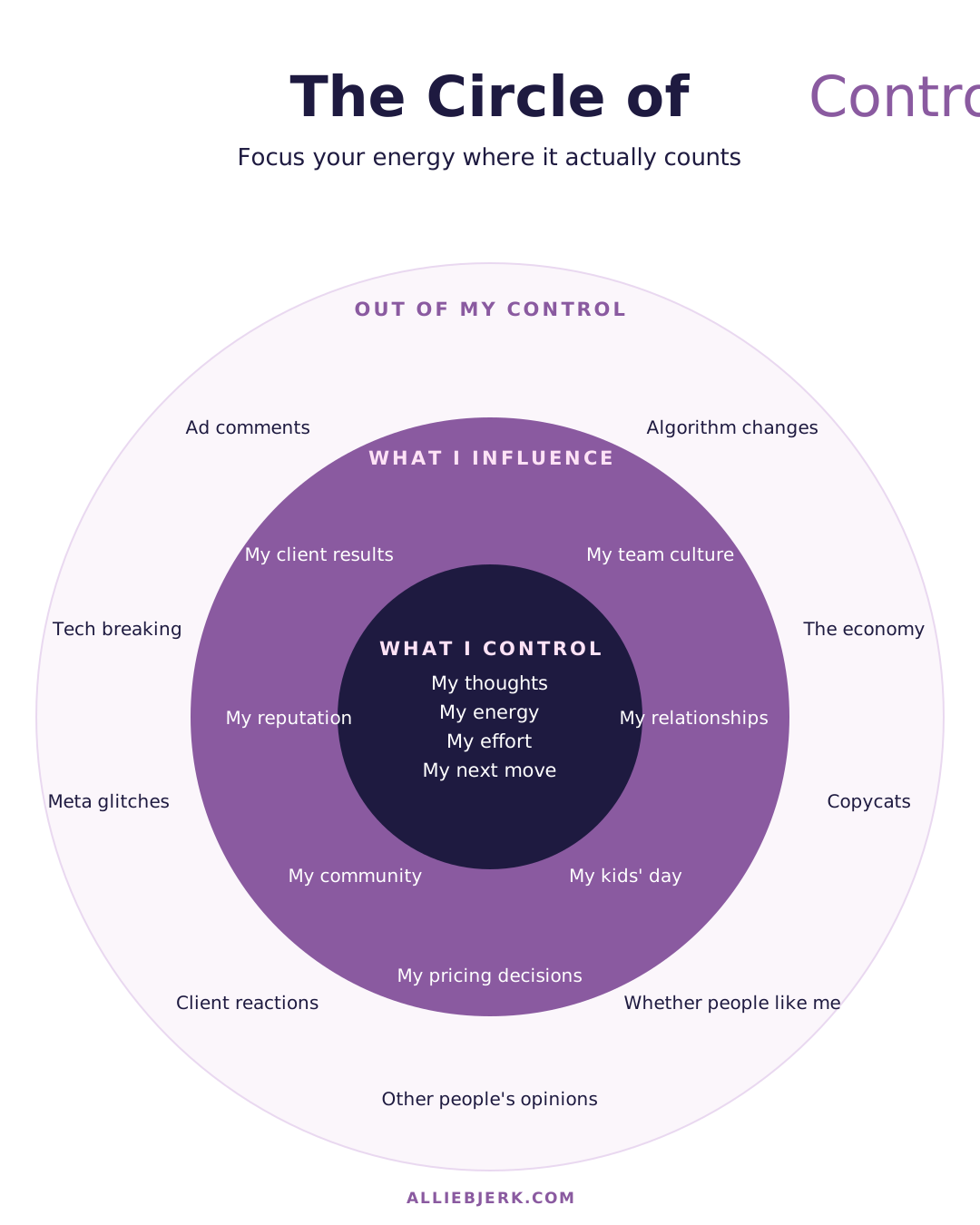
I put myself in therapy recently to digest all of this, and I found the thread that runs through every story: control and people pleasing. I believed I could control how every person interpreted me at every turn. I believed that if I behaved the right way, people would have to like me. Hypervigilance like that is a trauma response, and I genuinely think every entrepreneur should be in therapy, because your business is always downstream of your self-beliefs.
This shows up in my clients constantly. On a coaching call last week, a client admitted she’d been turning down her ad spend. Her ads were profitable. Everything was working. When I asked why, she didn’t have an answer beyond a vague feeling that she was spending too much. That feeling was scarcity talking, the same “what if I become too much” fear dressed up as prudence.
The framework that reframed this for me is the circle of control. Picture three rings. The center is you: your thoughts, feelings, energy, and actions. That’s the only ring you fully control. The middle ring is your sphere of influence, things like your relationships, where your behavior has impact without guaranteeing outcomes. The outer ring holds everything else: the behavior of people you hire, comments on the internet, clients who join your program and find a reason to be mad at you. Every single thing I feared lived in that outer ring, which means no amount of vigilance was ever going to prevent it.
The growth all happens in the center circle. Your energy, your effort, your next move.
So, what would you do if you were ten percent less scared?
Doing it scared looks tangible and specific. It looks like scaling the campaign that’s working even though your body remembers the last time ads went sideways. Posting the video. Putting your name on your framework. Owning your expertise even without the certification you think you need, because helping people rarely requires the credential your fear insists on.
You don’t need to be less afraid before you make the next move, and you don’t need to know exactly how it turns out. You just have to make the next slightly bigger move. Start tiny, show up a little bit bigger than your fear wants you to, and let yourself get a little uncomfortable.
So answer the question honestly. What would you do this week if you were just a little less scared?
Now go do some version of that.
This post is based on an episode of the Start Tiny Show. Listen to the full episode wherever you get your podcasts, and if it resonated, send me a DM and tell me what you’re doing scared this week.
-
<
The question every expert is asking right now
Allie has been hearing the same question on strategy calls, in masterminds, and in DMs: “If AI can teach everything I know for free, how do I keep making money?”
She opens with a story from her friend Colin Boyd, who ran a five-day challenge and watched attendees upload the transcripts to AI, build their own custom GPT from his framework, and decide they no longer needed his $3,000 program. The gate around expertise is gone.
The honest spiral
Allie gets real about her own crisis of confidence over the past year. Ads are more expensive across every industry. Meta’s Andromeda update changed how ads run entirely. Big names are shutting down programs and pivoting. Courses that deliver only information are in trouble.
But the data tells a different story than the doom does: buyers are still spending, arguably more eagerly than before. What changed is what they’re buying.
The 4 things people still pay for
1. Tools that do the work (tiny SaaS) Buyers used to pay to learn how. Now they pay for done. Allie shares two client examples:
- A headhunting expert with 20 years of experience had a multi-module course on writing job ads that had stopped selling. They rebuilt it as a micro app: answer a few questions, and her framework produces your finished job ad. The quick win went from “watch these videos” to “here is your completed job ad.”
- Another client had a revenue projection spreadsheet buried inside a mid-ticket course. With AI, that spreadsheet became an interactive calculator sold as a front-end product, backed by a creator walkthrough video so the expertise stays visible.
You can now be a software builder with the help of AI. These interactive front-end products are selling like crazy.
2. Personalized feedback and judgment AI gives you general best practices. It averages everything on the internet, which is exactly why AI copy has no rhythm. What it can’t do is look at YOUR specific offer with 15 years of pattern recognition and say “here’s what’s wrong and here’s what I’ve seen work in your niche.”
Allie shares what she keeps hearing on her 20-minute calls: “I just want your blessing. I just want the green light.” That demand for expert judgment is an offer waiting to be built. Audits that used to take hours of manual work can now be systematized and sold at low ticket prices, and buyers love them.
3. Speed and certainty People pay to skip the figuring-out stage. Finished assets, plug-and-play systems, decisions made for them, proof behind it all. Allie shares meeting Leah Gervais at Social Media Marketing World, whose best sellers are behind-the-scenes PDF breakdowns of her own launches with Loom walkthroughs. Buyers want the tea on what’s actually working inside other businesses, and AI can’t tell them why one email made $80K and another flopped.
4. Tangible hope Building on the last episode about selling hope: when someone plugs their numbers into an interactive calculator and sees what’s possible for THEM, that sells possibility. A personal, specific outcome beats any mini course.
Your homework this week
Look at your current offer and ask one question: does this do the work, or does it just describe the work? If every module, template, and bonus only teaches, it’s competing with free.
Then take your single best framework and sketch one way to make it interactive: a calculator, an answer generator, a quiz that outputs a personalized plan, an app that takes inputs and hands back a finished asset. You already own the IP. You’re repackaging it, and you can get it done in hours instead of months with a dev team.
The opportunity nobody’s talking about
There are vibe coders building incredible tools right now who have no idea how to market them. If you’re not comfortable building with AI yet, partner with a builder. Their tool plus your audience and expertise is a front-end offer that feeds your coaching world.
Small creators can move faster than anyone. You’re one tiny tool away from a new revenue stream.
Resources mentioned:
- Allie’s product naming tool
- The Offer Suite Wheel
(Both updated for 2026!)
Join Allie Inside Tiny Offer® HQ
If you’re building a business around your expertise, come hang out inside the Start Tiny HQ community. Start with a 7-day free trial, then it’s just $3/month for access to Allie’s courses, the community, and two live workshops with Allie on Zoom every month.
Want more hands-on support? The $287/month level adds weekly Zoom coaching calls with Allie plus weekly copy coaching calls with the copywriter on her team. That’s two to three live coaching calls every week.
Connect with Allie
- Coaching and 1:1 Strategy: https://tinyoffer.com/coaching/
New episodes of The Start Tiny Show drop weekly. If this episode gave you a lightbulb moment, share it with a business friend who’s been watering down their copy.
-
<
What Your Buyers Are Actually Paying For
The Start Tiny Show with Allie Bjerk
Episode Description
For years, a little voice in the back of Allie’s head whispered that she was “just selling hope.” That online business dreams, freedom, and money while you sleep were promises no ethical marketer should make. Then she went back and read hundreds of testimonials and found the same phrase over and over: you gave me hope.
In this episode, Allie unpacks why hope is one of the most honest things you can sell, the difference between real hope and false hope, and a dead-simple filter (she calls it the hope box) that will change how you write every headline, ad, and offer from here on out. If you’ve ever watered down your copy because a bold promise felt icky, this one’s for you.
What You’ll Learn
- Why “sell the transformation” freezes most business owners, and the one-sentence question that works instead
- The real line between selling hope and selling false hope (hint: it comes down to the vehicle behind the promise)
- Why hedging and qualifiers make your marketing weaker without protecting anyone
- How to lead with hope and tuck the work inside your offer, in that order
- The “hope box” filter to run every offer, headline, and ad through
- The responsibility that comes with selling hope boldly: over-delivering on the path
Episode Highlights
[00:00] The guilt spiral: “Am I just a hope dealer?” Allie shares the voice that haunted her every time she reread her own sales pages, ads, and launch emails.
[01:54] The testimonial pattern that changed everything. Hundreds of clients kept writing some version of the same sentence: “You showed me it was possible.”
[02:49] A walk in San Diego with Tara Zirker, who told Allie that watching her collect her 2 Comma Club Award as a mom with little kids was the moment she decided her own business was possible.
[05:10] Where the guilt started. After $7M+ in revenue driven by paid ads, Allie internalized the belief that painting a picture of someone’s better future was manipulative, and started shrinking her promises until they felt “safe.”
[06:16] The truth about hope: your buyers show up already carrying it. The mom scrolling at midnight, the burned-out corporate employee Googling “how to start an online business.” The only question is whether your message meets that hope or ignores it.
[06:39] Michelle Terpstra’s Trader Joe’s parking lot story, and why watered-down copy never makes anyone cry tears of relief.
[08:14] The mastermind leader who stood in front of 50 paying clients and told them most of them would never make it, and the vow Allie made in that room.
[10:08] Allie’s own buying behavior this year: a health coach, a leadership coach, a nervous system program. Every single purchase was a purchase of hope.
[12:20] The distinction that matters: false hope is a promise with no vehicle behind it. A proven framework, method, or system makes illustrating the result a service. Hiding it leaves people alone with the dream and no map.
[14:15] Coaching breakthrough inside the Accelerator: a homeschooling client who can’t promise “50% improvement in three weeks” because she works with children, family systems, and emotions. The reframe that gave her goosebumps.
[15:27] One-sentence hope statements in action: sales closers, elite athletes, homeschooling parents, and Allie’s own buyers (“hoping an online business can fund the life they actually want”).
[16:41] The hope box filter, and the trap almost everyone falls into: building offers that sell work (set up your analytics, learn the framework) when nobody wakes up hoping to do setup.
[17:21] The upgrade to Allie’s long-standing “sell the easy button, save them time” rule: save them time AND check the hope box.
[18:40] The formula: illustrate the hope, deliver the work, in that order.
[19:02] Selling hope with integrity. If someone buys the hope and you hand them fluff, that’s when it becomes sleazy. Bold hope requires over-delivering on the path.
Quotable Moments
“What is the hope that my audience is carrying? Can I say that in one sentence? That’s how simple it gets.”
“False hope is a promise with no vehicle behind it.”
“Illustrate the hope, deliver the work, and do it in that order.”
“You are allowed to sell hope. And if you have a real path behind it, you are obligated to share it.”
Your Homework This Week
- Mine your own proof. Read your testimonials, DMs, and thank-you emails. Highlight every sentence about possibility, belief, or hope. That language is gold. Weave it into your headlines, copy, ads, and offers.
- Draft your one-sentence hope statement. “My people are hoping ______.” If you can’t fill in that blank, you’ve found your real messaging problem, and no amount of funnel tweaking will fix it.
- Audit your front end. Look at your current offer, headline, or best ad and ask honestly: does this check the hope box, or does it sell work? If it sells work, rewrite the front of it to lead with hope.
Join Allie Inside Start Tiny HQ
If you’re building a business around your expertise, come hang out inside the Start Tiny HQ community. Start with a 7-day free trial, then it’s just $3/month for access to Allie’s courses, the community, and two live workshops with Allie on Zoom every month.
Want more hands-on support? The $287/month level adds weekly Zoom coaching calls with Allie plus weekly copy coaching calls with the copywriter on her team. That’s two to three live coaching calls every week.
Connect with Allie
- Website: alliebjerk.com
- Community: Start Tiny HQ
- Learn the method: Tiny Offer® Lab
New episodes of The Start Tiny Show drop weekly. If this episode gave you a lightbulb moment, share it with a business friend who’s been watering down their copy.